Core question: Can you split a complicated region into shapes whose areas you already know? The three AMC 8 problems below come from 2024 and 2026 past papers. The practice problems are original.
1. The principle: keep track of what is included
Area is additive: nonoverlapping pieces can be added. If a simple outer shape contains an unwanted inner shape, subtract the inner area.
For a shaded border around a rectangle, the dimensions of the inner rectangle are smaller on both sides:
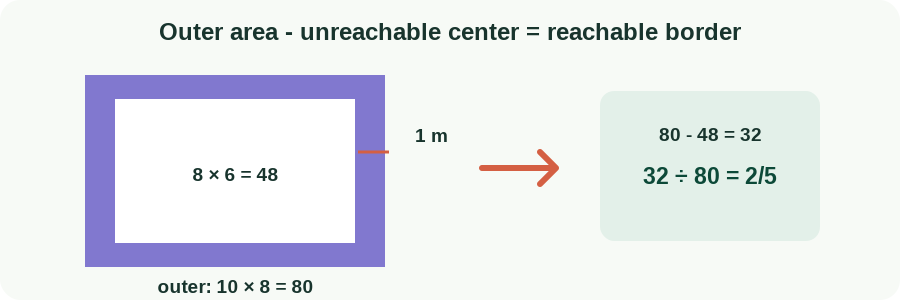
Why is the inner width rather than ? The border takes one unit from the left and one from the right. The same happens at the top and bottom.
Three useful moves
| Picture you see | Move | Check |
|---|---|---|
| A frame or border | Outer area − inner area | Subtract the border width twice per dimension. |
| Alternating nested regions | Add shaded layers; subtract holes | Track each layer’s color. |
| Triangle on a coordinate grid | Base × perpendicular height ÷ 2 | The height is a distance, not a slanted side. |
2. Real AMC 8 problems
2026 AMC 8, Problem 6 · The reachable border
A rectangular field is 10 m by 8 m. Peter can reach berries within 1 m of any edge. What fraction of the field can he reach?
Choices: A. · B. · C. · D. · E.
The unreachable center is m by m, as shown in the border diagram above. Thus
The requested fraction is , choice E. An area of 32 alone is not the answer because the question asks for a fraction of the entire field.
View the original figure, page 5.
2024 AMC 8, Problem 3 · Alternating nested squares
Squares with side lengths 4, 7, 9, and 10 share their left and bottom edges. From smallest to largest, they alternate unshaded, shaded, unshaded, shaded. What is the visible shaded area?
Choices: A. 42 · B. 45 · C. 49 · D. 50 · E. 52
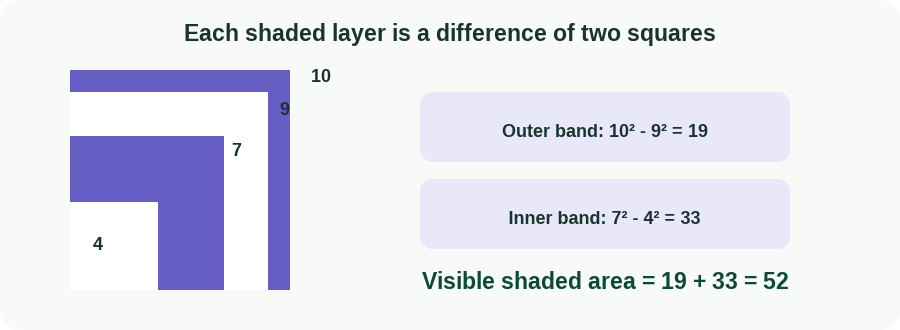
The visible shaded parts are two nonoverlapping bands:
The answer is choice E. Do not add the full areas and : the smaller unshaded squares cover parts of them.
View the original figure, page 3.
2024 AMC 8, Problem 11 · A triangle on coordinates
Triangle has , , and , where . Its area is 12. Find .
Choices: A. 8 · B. 9 · C. 10 · D. 11 · E. 12
Points and lie on the horizontal line , so is an easy base. The perpendicular height from to that line is .
Therefore and , choice D. The horizontal location of does not change the height from the line .
View the original question, page 7.
3. Prediction questions · Original practice
Question 1 · A wider frame
A cm by cm rectangle has a cm wide border along all four inside edges. What is the border’s area?
Choices: A. 19 · B. 36 · C. 38 · D. 40 · E. 70
Answer and reasoning
C. 38 cm². The inner rectangle is by , or by . Subtract: .
Question 2 · More nested squares
Four squares with side lengths 3, 5, 8, and 10 share their left and bottom edges. From smallest to largest, they are unshaded, shaded, unshaded, shaded. What is the visible shaded area?
Choices: A. 48 · B. 50 · C. 52 · D. 54 · E. 56
Answer and reasoning
C. 52. Add the two shaded bands: .
Question 3 · Horizontal base, vertical height
A triangle has vertices , , and . What is its area?
Choices: A. 18 · B. 21 · C. 24 · D. 30 · E. 48
Answer and reasoning
C. 24. The horizontal base has length . The vertical height is . Area .
4. A quick decision guide
- Find a simple whole shape. Can you see a rectangle, square, or triangle whose area is easy?
- Mark every missing or covered part. Shading is about what remains visible.
- Write an area equation before calculating. For example, .
- Check the requested unit. Area, fraction of an area, and a missing coordinate are different answers.
Self-check: In a by rectangle with a -unit inner border, why is the center by ? If you can point to the two removed strips in each direction, you understand the method.