Source note: The two AMC 8 questions below are translated and lightly reworded from the local past-paper PDFs. The three prediction questions are original practice questions about recurring skills, not claims about a future exam.
1. The idea: an average is a fair share
An average tells us what each item would have if the total were shared equally. Sharing changes the distribution, but not the total.
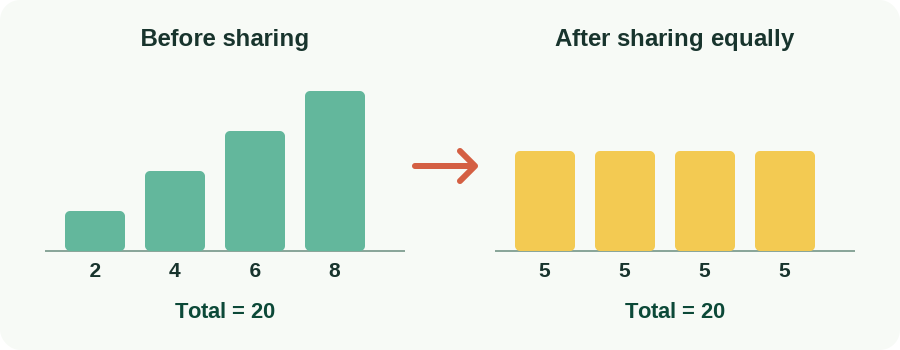
The picture gives two ways to read the same fact:
Useful habit: When a problem gives an average, first turn it into a total. For example, if two numbers average 21, their total is .
Two traps to avoid
- An average is not a total. “Two numbers average 21” means the two numbers sum to 42.
- Group averages need group sizes. A group of 12 and a group of 18 do not contribute equally to a combined average. Find each group’s total first.
2. Real AMC 8 problems
2022 AMC 8, Problem 16 · Overlapping pairs
Four numbers are written in order. The first two average 21, the middle two average 26, and the last two average 30. What is the average of the first and last numbers?
Choices: A. 24 · B. 25 · C. 26 · D. 27 · E. 28
Let the numbers be . Convert each average into a pair total:
We need . The diagram shows why adding the outside pairs and subtracting the middle pair works:
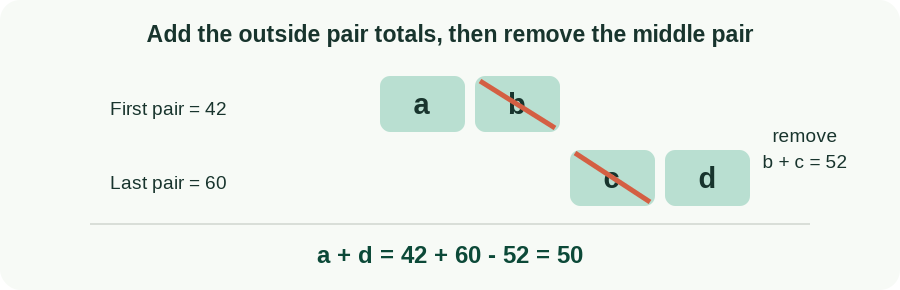
So the requested average is , choice B. We never need to find , , , or separately.
View the original question, page 12.
2025 AMC 8, Problem 9 · An average of pair averages
On a clock, make the six pairs of numbers that face each other. Find the average of each pair, then the average of those six results. What do you get?
Choices: A. 5 · B. 6.5 · C. 8 · D. 9.5 · E. 12
The six pairs use each clock number exactly once. The diagram lists the six pair averages:
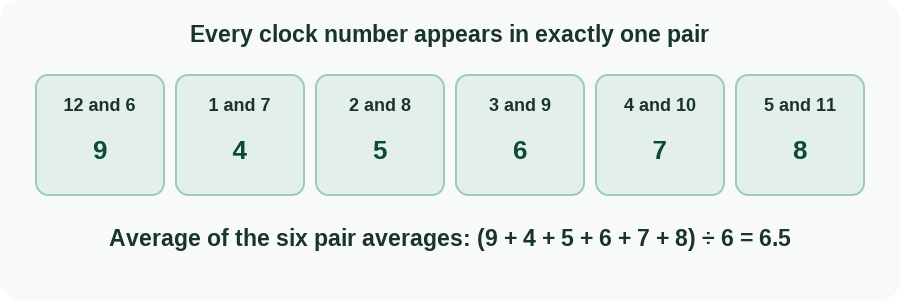
Each pair has two numbers, so each pair contributes equally. We can also combine all 12 numbers before averaging:
The answer is choice B. This shortcut works because every group has the same size and every number appears once.
View the original question and clock diagram, page 7.
3. Prediction questions · Original practice
Try these before opening the solutions. Each tests a different way to use total = average × count.
Question 1 · Replacing one value
Five numbers have an average of 12. One of the numbers, 8, is replaced by 18. What is the new average?
Choices: A. 12 · B. 13 · C. 14 · D. 15 · E. 16
Answer and reasoning
C. 14. The old total is . Replacing 8 with 18 adds 10 to the total. The new average is .
Question 2 · More overlapping pairs
Four numbers in order are . The averages of , , and are 14, 18, and 23, respectively. What is the average of and ?
Choices: A. 17 · B. 18 · C. 19 · D. 20 · E. 21
Answer and reasoning
C. 19. The three pair totals are 28, 36, and 46. The outside values total , so their average is . Use the same cancellation picture as in the 2022 problem.
Question 3 · Combining groups of different sizes
Group A has 12 students with an average score of 15. Group B has 18 students with an average score of 20. What is the average score of all 30 students?
Choices: A. 17 · B. 17.5 · C. 18 · D. 18.5 · E. 19
Answer and reasoning
C. 18. Think of each group as a box holding all its points:
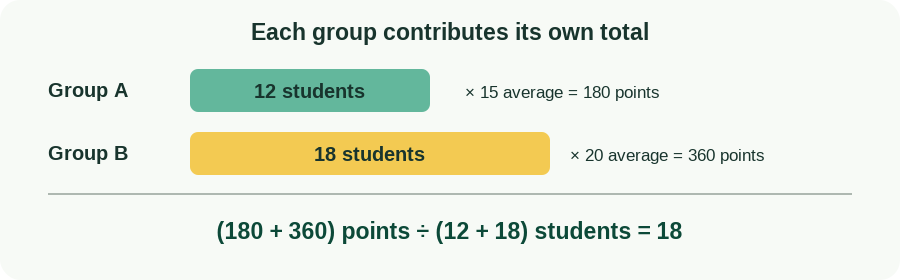
The 18-student group has more influence because it contains more scores. Simply averaging 15 and 20 would give the wrong answer.
4. Check your understanding
- If three numbers average 9, what is their total?
- In the 2022 problem, why do we subtract after adding and ?
- When is it safe to average several group averages directly?
Check: 1. . 2. It removes the two middle numbers, leaving . 3. When the groups are the same size (and together contain every item exactly once).